There is a kind of sales culture that gets praised far too often.
It is the culture that is always on.
On the surface, it can look like a high-performance environment.
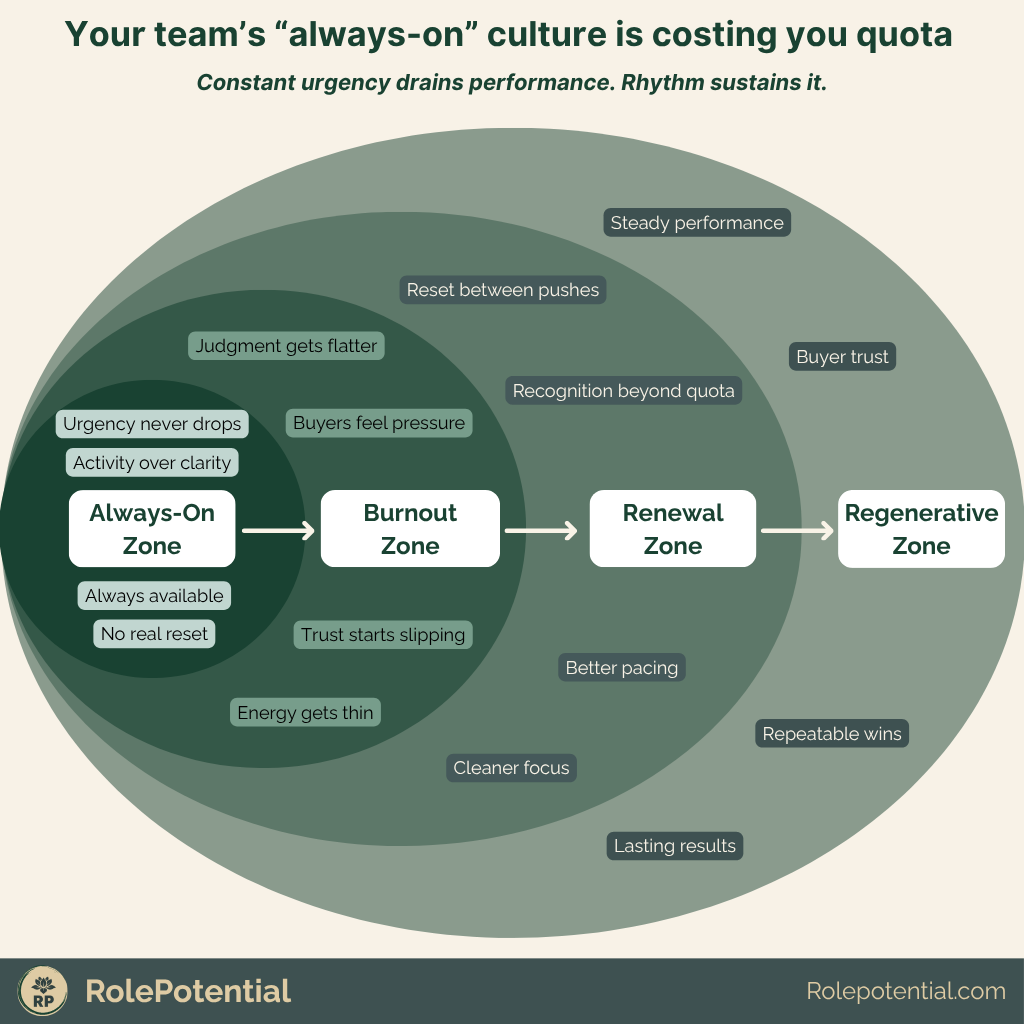
That is exactly why this kind of culture survives. It looks productive. But a culture can look intense while becoming less effective. That is the part many teams miss. An always-on culture does not just increase effort. It changes the quality of thinking inside the system. It makes urgency feel normal. It erodes recovery. It teaches people to override signal. It can make leaders more reactive, reps more strained, and buyers more pressured. And eventually, it starts costing the team the very thing it was supposed to protect: performance. Not all at once. Quietly.
The quota still gets hit in some months. The team still has strong people. The activity still looks high.
But underneath that visible layer, something starts weakening.
And the cost shows up where sales leaders feel it most: consistency. One of the five recurring problems in modern sales is systems running on constant urgency, and one of the regenerative responses is redesigning practices for resilience through rhythm, reflection, renewal, and pacing. That is what this piece is about.
Not whether hard work matters. But whether an always-on culture is helping your team perform, or quietly making quota harder to sustain.
Sales has always rewarded visible intensity. That makes sense in part. It is a performance-driven environment. Numbers are public. Timelines are compressed. Leaders are expected to respond fast. Teams are measured by output. So when a culture feels urgent all the time, it can look serious. It can look disciplined. It can look committed.
But visible intensity is not the same as healthy execution.
That is the issue with always-on cultures: they confuse activation with sustainability. The environment teaches that to care is to stay switched on. To lead is to maintain pressure. To perform is to override fatigue. To prove commitment is to stay reachable, responsive, and mentally activated at all times. For a while, that can create output.
But over a longer horizon, it creates drag. Because people are not machines. And sales performance is not just produced by effort. It is also produced by rhythm, recovery, clarity, and the ability to distinguish what matters from what merely feels urgent.
The first cost is cognitive.
When a team is always on, it loses contrast. Everything starts to feel important. Every notification feels relevant. Every deal feels like it needs immediate intervention. Every leadership message carries urgency. Every week starts to feel like quarter-end. That is bad for judgment. The best sellers are not just active. They are discerning. They know when to press and when to pause. They know when to accelerate and when to deepen alignment. They know the difference between real momentum and frantic motion. An always-on environment weakens that distinction.
The second cost is emotional.
A team that never really resets becomes emotionally flatter over time.
Wins do not restore as much. Losses drain more. Patience gets shorter. Curiosity gets replaced by reactivity. Defensiveness rises faster. The emotional bandwidth required for good selling starts shrinking.
The third cost is relational.
Buyers can feel when a seller is over-pressurized. The language gets tighter. The follow-up gets more forceful. The curiosity gets thinner. The interaction starts feeling more like pursuit than partnership. That matters because buyer trust is a core outcome of regenerative systems, and pairs leading indicators like buyer engagement and proactive communication with lagging indicators like renewal rate, NPS, and referrals.
The fourth cost is cultural.
Always-on cultures normalize depletion. They teach teams that strain is just part of excellence. They make it harder for people to speak honestly about what is draining energy. They create a performance story where burnout becomes invisible until it becomes expensive. And by then, leaders often respond the same way they respond to every other problem inside these systems: with more urgency.
This is the part that many teams resist. Because always-on culture often gets defended as the price of winning. But if a culture lowers the quality of decision-making, weakens buyer trust, increases turnover risk, compresses learning, and makes performance more erratic, then it is not protecting quota. It is destabilizing it. An always-on team may still produce bursts of strong performance. But bursts are not the same as stability.
Quota gets harder to sustain when:
Our Regenerative Sales playbook makes it clear that teams that honor rhythm build consistency, and that wellbeing is not a break from performance but part of it. That is why quota and culture are not separate conversations. A culture that burns energy faster than it restores it will eventually pay for that in performance.
But the invoice comes either way.

Urgency has a place in sales. That matters to say clearly. Regenerative sales is not anti-urgency. It is anti-permanent urgency. There are moments that require speed. There are deals that need pressure. There are periods where intensity makes sense. The problem is when intensity stops being contextual and becomes cultural. That is when urgency turns from tool into atmosphere.
Rhythm is different.
Our Regenerative Sales playbook lays out this shift directly through the Seasonal Sales model: spring for planting, summer for nurturing, fall for harvesting, winter for reflection and renewal. It argues that growth is cyclical, not linear, and that teams that honor seasons outperform teams that fight them. This matters because an always-on culture treats every phase like fall: Close. Push. Move. Force.
But sales is not all fall. Some moments need deeper discovery. Some need alignment. Some need coaching. Some need renewal. Some need cleanup and reset. A team that cannot change energy appropriately is not disciplined. It is miscalibrated.
Sometimes the easiest way to spot a pattern is to listen to its language.
Always-on cultures often sound like this:
None of those phrases are automatically wrong. But when they become the default language of the system, they reveal something important: the culture does not know how to regulate itself without pressure. That is dangerous. Because the best teams are not the ones that never feel urgency. They are the ones that know how to recover from it, learn from it, and avoid turning it into the only leadership tool they have.
There is no real variation in energy, pacing, or leadership tone.
The team is working, but energy is thinning faster than capability is growing.
Diagnosis comes second. Pressure comes first.
Follow-up gets tighter, trust gets thinner, and deals feel pushed.
Even after wins, there is little sense of reset, closure, or restoration.
If several of those feel familiar, it does not mean your people are weak. It usually means your current environment is running on extraction faster than regeneration.
A regenerative culture does not remove standards. It changes how standards are sustained. Instead of relying on permanent activation, it builds repeated practices that restore clarity, focus, and trust. Our Regenerative Sales Playbook names several of these directly: reflection huddles, Monday and Friday renewal rituals, recognition beyond quota, energy check-ins, and leadership questions that surface what is draining or restoring the team. That is a major shift. Because in an always-on culture, renewal is often treated like softness. In a regenerative culture, renewal is treated like maintenance. And maintenance is what protects performance.
A regenerative culture:
That is not theoretical. It changes what the week feels like. Meetings get cleaner. Energy gets more legible. Coaching gets more useful. Buyers feel less rushed. The team becomes more honest about what is working and what is draining. And performance becomes easier to repeat without emotional overextension.
One of the biggest traps in always-on culture is recognition. If a team only recognizes wins that came through extreme effort, then the culture teaches that depletion is what deserves praise. That is a bad lesson. Our playbook is strong on this point. It says recognition should go beyond quota and include resilience, mindset wins, reflection, and the question: “What’s giving you energy right now?”
That is not fluffy. It is strategic.
Because what gets recognized gets repeated. If the culture celebrates heroics, people will keep overextending. If the culture celebrates steadiness, people will build repeatable strength. If the culture notices energy management as part of good performance, the team will stop treating exhaustion like proof of commitment.
This is where culture changes. Not just in big declarations. In repeated reinforcement.

Most leaders cannot flip a culture overnight. But they can start changing what the team experiences every week. Here are five practical shifts.
Our playbook’s Friday Renewal Ritual is powerful for this: gratitude notes, pride list, open-loop brain dump, support planning, and a note to future-you. That creates completion. Completion matters because incomplete mental load is one of the things that keeps teams perpetually switched on.
Instead of starting the week with raw urgency, start with top priorities, aligned deals, and intentional human touchpoints. The Monday ritual in the playbook does exactly that.
If meetings only reward updates and outcomes, people will hide fatigue and skip reflection. If meetings also value learning, signal, and better pacing, the system gets smarter.
Seasonal language helps teams understand that not every moment requires the same energy. Your playbook explicitly recommends this.
A team does not get healthier just because leadership privately cares. It gets healthier when people can name what is restoring or draining the work without being seen as weak.
A healthier sales culture does not feel lazy. It feels steadier. There is still ambition. Still urgency when needed. Still accountability. Still directness. Still performance focus. But the environment stops using stress as its main organizing principle. That changes a lot.
That is what sustainable performance feels like. Not flat. Not soft. Just more durable.
If you are leading a sales team, the real question is not:
Does our culture feel intense?
It is:
Is our intensity making us stronger? Or is it making performance more expensive than it needs to be?
Because an always-on culture may look committed. It may even look impressive from the outside. But if it is lowering judgment, thinning trust, normalizing fatigue, and making quota harder to sustain, then it is not a strength. It is a drag.
Regenerative sales offers a different path. Not less performance. Not less accountability. A better operating rhythm. One where teams do not need to live in permanent activation to do great work. One where energy is managed, not just spent. One where renewal is part of performance. One where culture does not just extract output, but helps people and results grow together.
That is the shift. And it is one more sales leaders can no longer afford to ignore.