There are few leadership moments in sales more revealing than a pipeline review. Not because of the deals. Because of what the review teaches the team.
Every pipeline review communicates something deeper than stage progression, close dates, and forecast confidence. It teaches people what leadership sounds like under pressure. It teaches reps what is safe to say, what is risky to say, and what kinds of answers are actually rewarded. It teaches managers whether their job is to inspect, interrogate, or develop. And it teaches the entire team whether deals are something to understand or something to defend.
That is why pipeline reviews matter so much.
Most leaders think pipeline reviews are about visibility. The best ones know they are about conditioning.
That's why at RolePotential, we coach on how a pipeline review can train a rep to think more clearly, notice buyer patterns earlier, and improve decision-making over time. Or it can train that same rep to become guarded, overprepare surface-level updates, hide uncertainty, and manage leadership perception instead of managing the deal well.
This is where a lot of sales teams quietly lose performance. Not because they do not have enough pipeline meetings. Because the meetings themselves are shaping the wrong behaviors.
Our Regenerative Sales Playbook (DM me and I'll send it over) makes this distinction clearly. It reframes pipeline reviews from interrogation to exploration and emphasizes questions that surface patterns, buyer signals, energy, and learning rather than fear-based grilling.
Most sales leaders did not inherit a healthy model for running pipeline reviews.
So pipeline reviews often become one of the main places where organizational stress gets transferred onto the team.
And the review turns into this:
Those questions are common because they feel direct. They sound accountable. They create the appearance of rigor. But in practice, they often produce something else. They make reps defend instead of think. They narrow attention to status instead of pattern. They reward confidence theater over clarity. They create more pressure around deals that usually need better understanding, not more force.
A pipeline review can look efficient on the surface and still weaken the sales system underneath.
That is the trap.
A draining pipeline review as well as other sales execution challenges don't just make meetings unpleasant. They changes behavior.
When reps know they are walking into an environment where stalled deals trigger scrutiny more than support, they adapt. They become cautious with uncertainty. They simplify complex situations into safer narratives. They over-index on what leadership wants to hear. They protect themselves. That means the review loses the very thing it is supposed to create: signal.
Instead of surfacing what is really happening in the deal, the team surfaces polished fragments. Instead of discussing buyer readiness, trust gaps, or decision friction, they discuss stage language. Instead of getting better at reading patterns, they get better at surviving the meeting. That has consequences.
Eventually, pipeline reviews become expensive. Not because they take time. Because they train the wrong habits.
Every recurring leadership ritual has a curriculum, whether intentional or not. Pipeline reviews are no different.
They teach the team:
That is why the style matters as much as the structure. You can have the right CRM fields, the right dashboard, the right meeting cadence, and still have a review culture that drains performance because the emotional pattern is wrong.
A lot of teams think they have a pipeline problem when they really have a review problem.
The pipeline review is where many of the system’s assumptions become audible. If leadership defaults to interrogation, the team learns that slowing down to think is risky. If leadership defaults to blame, the team learns that missed expectations are safer when disguised. If leadership defaults to urgency, the team learns that the answer to friction is intensity.
That does not create better sellers. It creates more anxious ones.

A regenerative pipeline review still takes performance seriously. It still creates accountability. It still deals with reality. It still looks at movement, risk, next steps, and execution. But it changes the purpose of the meeting. Instead of asking, “How do we pressure this deal forward?”
It asks, “How do we understand what is happening well enough to move wisely?”
That is a different posture.
Our Regenerative Sales playbook gives excellent examples of this shift. Traditional questions like “Why is this deal stuck?” and “When will this close?” are replaced with regenerative alternatives like “What pattern led us here?” and “What does the buyer need to feel ready?”
That one change alters everything.
A regenerative review helps the rep think better. It gives the leader better information. It surfaces where pressure is distorting behavior. It makes buyer understanding part of the review, not just seller activity. It builds trust instead of fear. That is why regenerative reviews are developmental by nature.
They are not just about this week’s commit number. They are about whether the team is building judgment, adaptability, and honesty over time.
This is the real dividing line. A draining pipeline review interrogates. A developmental pipeline review explores.
Interrogation sounds like:
Exploration sounds like:
Exploration is not vague. It is actually more precise. t gets closer to the truth because it does not punish complexity.
Buyers do not move in neat CRM language. Deals do not stall for one simple reason. Most late-stage friction is not solved by louder follow-up. It is solved by better insight. Exploratory questions increase the chances of finding that insight.
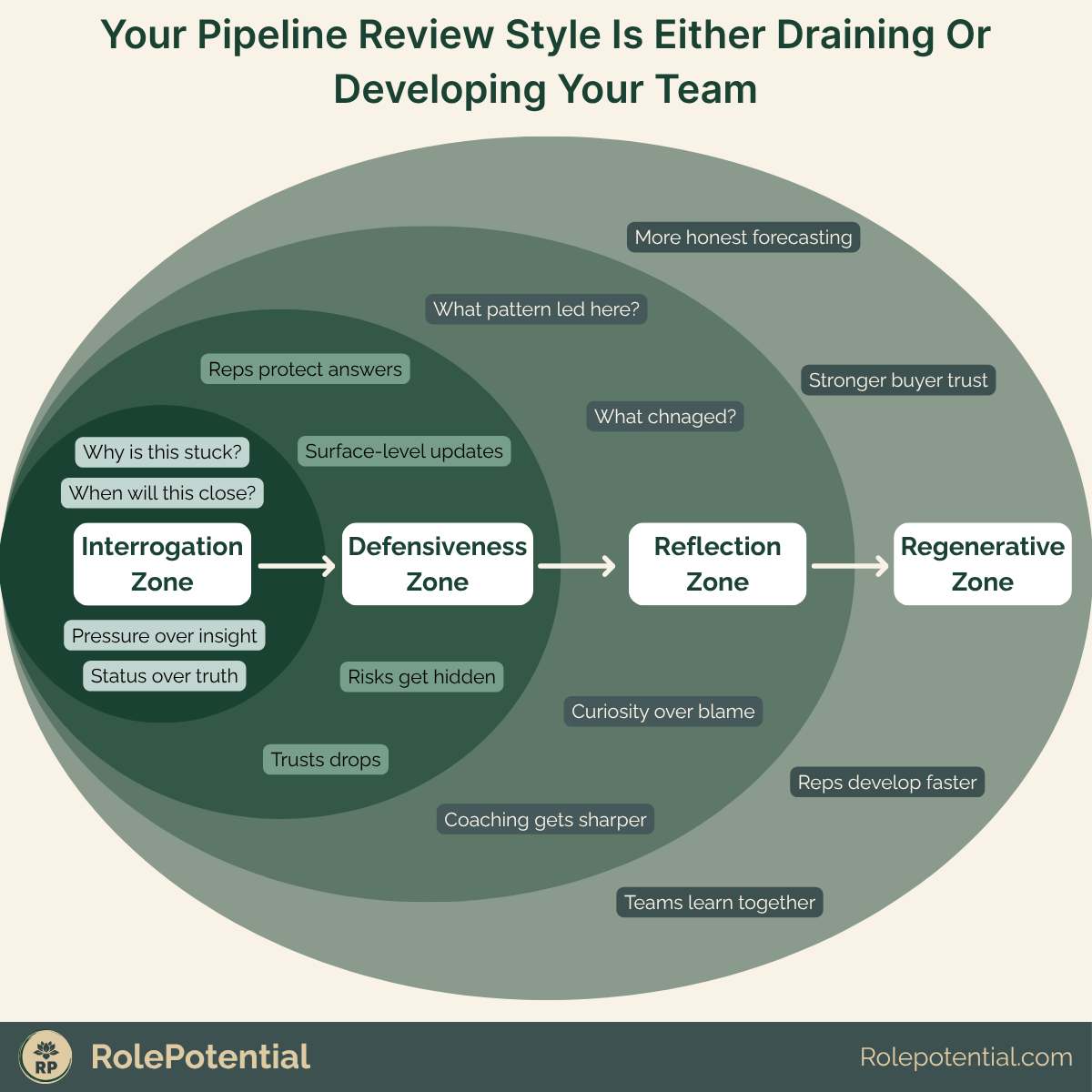
If a pipeline review is going to develop a team, trust has to be present. Not blind trust. Not low-accountability trust. Useful trust. The kind of trust that lets a rep say:
Those are high-value statements. But they only show up when the review environment allows honesty without punishment.
The Regenerative Sales playbook and our sales courses emphasize that fear creates compliance while trust creates creativity, and that psychological safety is where accountability grows. That is exactly right in pipeline reviews. Without trust, the team hides signal. With trust, the team shares it. And signal is what improves performance.
The best leaders understand that trust is not separate from accountability. It is what makes accountability productive. A rep who trusts the review process will surface risk earlier. A leader who builds trust will get better data sooner. A team that trusts the room will improve faster because it spends less energy self-protecting.
You get update language, not real analysis.
The review centers on stage, date, and surface action instead of buyer dynamics or decision patterns.
The meeting escalates intensity instead of improving understanding.
The review creates emotional load but not strategic next steps.
The team talks about deals often, but capability is not compounding.
If those patterns are showing up, the issue may not be your people. It may be that your review ritual is reinforcing defensiveness instead of development.

Do not just ask where the deal is. Ask how it got there.
Pattern questions reveal more than stage questions:
A pipeline review should not only measure seller activity. It should assess buyer movement.
Ask:
If a leader is anxious, the review will carry that anxiety unless it is managed intentionally.
Leaders have to notice when they are trying to discharge pressure through sharper questioning. That may create movement, but it often lowers quality.
A good review does not just advance a deal. It strengthens the rep.
Try:
These questions come directly from the regenerative pipeline approach in your playbook.
Pipeline reviews should reveal recurring friction in the larger environment.
Are pricing conversations getting rushed?
Are discovery standards uneven?
Are managers over-coaching late stages and under-coaching early alignment?
Are certain buyer patterns getting missed repeatedly?
When leaders notice these patterns, reviews become system-shaping, not just deal-checking.
A strong regenerative pipeline review feels different than many people expect. It feels calm. Focused. Direct. Honest. Useful. Not easy. Not casual. Not soft. Just clean.
That kind of review develops both the pipeline and the people inside it.
Over time, it creates a different kind of sales team.
That is development.
Pipeline reviews are one of the most repeated leadership moments in the sales rhythm. That means they are never neutral. They are either teaching fear or teaching judgment. Teaching defensiveness or teaching awareness. Teaching surface updates or teaching pattern recognition. Teaching the team to brace or teaching the team to grow. This is why they matter so much.
For sales leaders, the opportunity is bigger than improving a meeting. It is improving the conditions under which better performance becomes possible. That is the larger RolePotential principle. Strong systems do not rely on pressure everywhere. They create repeated moments where better behavior gets reinforced until it becomes the team’s new normal. Pipeline reviews are one of those moments.
If they are done well, they become one of the fastest ways to raise honesty, trust, coaching quality, and deal intelligence across the team. If they are done poorly, they quietly drain all four.
The question is not whether your team needs pipeline reviews. It does. The question is what your current review style is producing.
Because most pipeline reviews do one of two things. They either drain the team. Or they develop it. And once you see that clearly, it becomes much harder to keep calling a fear-heavy meeting “accountability.”
Real accountability builds better sellers. That is what regenerative pipeline reviews do. They do not just inspect the pipeline. They strengthen the people responsible for it.