

Sometimes the deal does not stall because the buyer lost interest. Sometimes it stalls because the salesperson is selling to the wrong buyer mode.
A buyer may still care about the problem. They may still believe the solution could help. They may still see the value. But if the sales approach does not match how that buyer is listening, thinking, learning, and deciding in the moment, momentum starts to fade.
The rep thinks they are helping. The buyer feels misunderstood. And the deal quietly slows down.
This is one of the most overlooked reasons strong opportunities lose energy. Not because the product was wrong. Not because the buyer was difficult. Not because the rep failed to communicate value. But because the conversation was aimed at the wrong behavioral cluster.
Most sales teams define buyer personas by role.
Chief Revenue Officer.
Head of HR.
VP of Operations.
Founder.
Director of Sales.
Procurement.
Those titles are helpful. But they do not tell you how the person is processing the decision. Two buyers can have the same title and need completely different things to move forward. One may need proof. One may need a roadmap. One may need the relationship to feel safe. One may need the future vision. One may need speed. One may need reassurance.
This is why RolePotential’s Behavioral Clusters focus less on who the buyer is on paper and more on how they move through decisions.
Because deals do not move through titles, they move through people.
And people make decisions differently.
A mismatch happens when the salesperson gives the buyer something that may be valuable, but not valuable to that buyer in that moment.
For example:
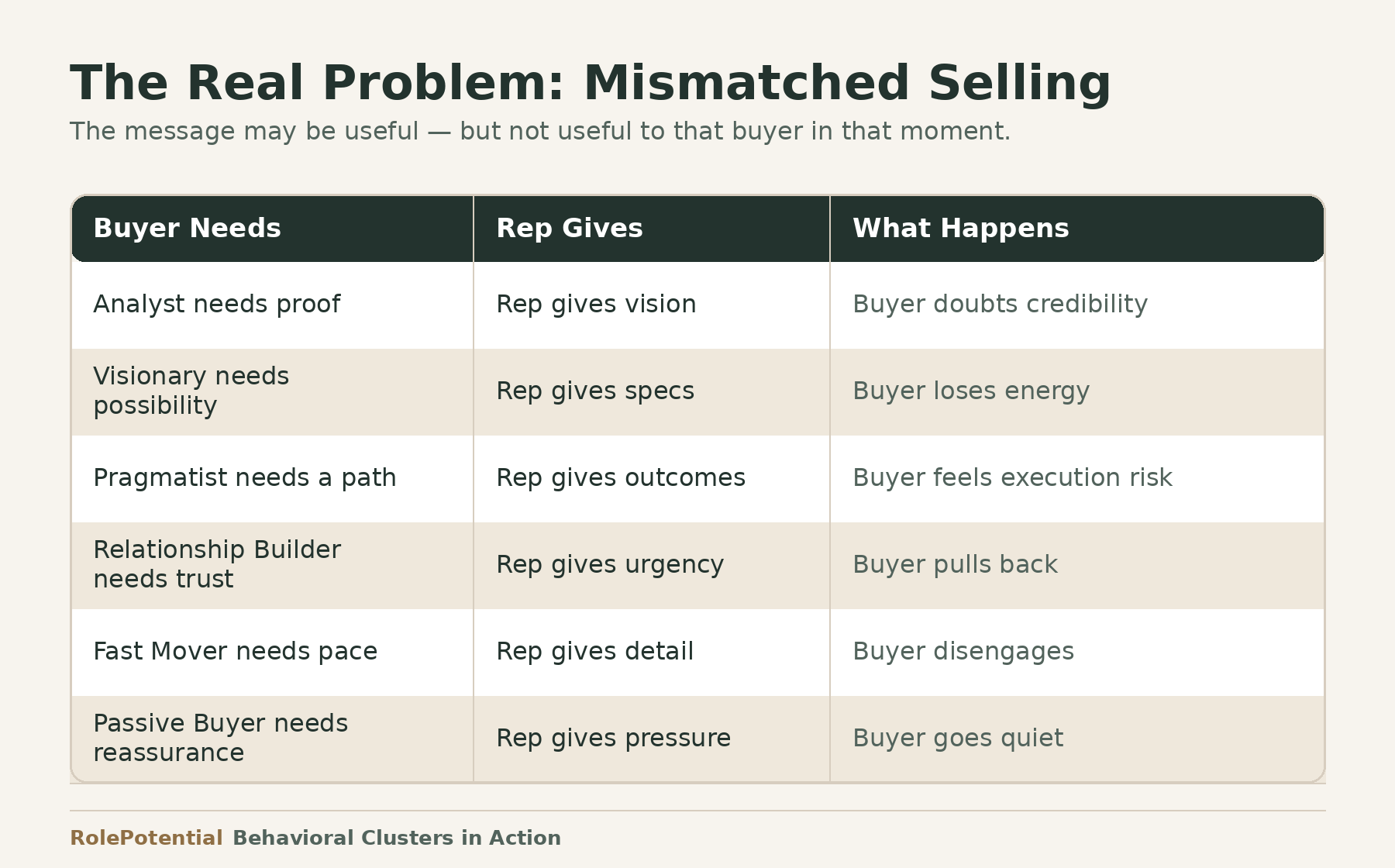
The rep may not be wrong. The message may not be bad. It is simply mismatched.
And in sales, a mismatched message often feels like friction. The buyer may not say, “You are selling to the wrong version of me.”
The opportunity does not collapse. It drifts.
Buying already carries uncertainty. The buyer is evaluating risk, cost, timing, internal alignment, personal credibility, and future impact. When the sales conversation matches how the buyer is processing that uncertainty, confidence grows. When it does not, uncertainty increases.
The Analyst thinks: “This sounds interesting, but I do not have enough evidence.”
The Pragmatist thinks: “This seems valuable, but I do not understand how we would implement it.”
The Relationship Builder thinks: “They seem capable, but I do not know if I trust the partnership yet.”
The Fast Mover thinks: “This is taking too long.”
The Passive Buyer thinks: “This feels like too much.”
The Visionary thinks: “This feels smaller than the opportunity I care about.”
The Idealist thinks: “This does not feel connected to the deeper purpose.”
The Explorer thinks: “This feels too rigid.”
Those thoughts matter. Because once the buyer feels misunderstood, the salesperson has to work harder to create momentum. Not because the deal is dead. Because confidence was not built in the right place.

The Analyst buyer wants proof. They need structure, criteria, comparison, evidence, and logical clarity. But many reps respond to their caution by painting a bigger vision.
They say: “Imagine where this could take your team.”
That may work beautifully with a Visionary. But with an Analyst, it can create distance.
The Analyst may be thinking: “Before I imagine the future, I need to know if this actually holds up.”
What they need is not more excitement. They need a clearer decision structure.
A better response sounds like: “Let’s map the criteria your team will use to evaluate this, then we can identify what proof would make the recommendation feel credible.”
That creates movement because it matches how the Analyst builds confidence.
The Visionary buyer wants possibility. They want to understand what the decision could unlock. They care about growth, future impact, innovation, and strategic direction. But many reps get nervous when Visionaries think big. So they pull the conversation back to features, specs, and immediate use cases too quickly.
The rep may think they are being practical. The Visionary may feel the energy drop.
What they need first is not every detail. They need the future state.
A better response sounds like: “Let’s start with where this could take the business, then we can ground that vision in the first practical milestone.”
That gives the Visionary what they need without letting the conversation drift into fantasy. It honors the future and creates a path.
The Pragmatist buyer needs to know how this will work. They care about implementation, workflow, timing, responsibilities, and operational fit. But many reps keep selling outcomes after the buyer already understands the value.
They repeat: “This will help you improve efficiency.”
The Pragmatist is thinking: “I believe that. But how exactly do we get there?”
This is where deals stall. Not because the buyer does not see the outcome. Because the path feels unclear.
A better response sounds like: “It sounds like the value makes sense. Let’s walk through the first 30 days so you can see what implementation would actually require.”
For the Pragmatist, clarity is not extra. Clarity is the close.
The Relationship Builder buyer needs trust. They care about partnership, support, collaboration, and the people behind the solution. But when the deal gets close, reps often shift into urgency.
They ask: “What do we need to do to get this done by Friday?”
That question may be appropriate in some deals. But with a Relationship Builder, it can feel transactional if trust is not fully built.
They may wonder: “Are they still partnering with us, or are they just trying to close?”
A better response sounds like: “Before we move forward, I want to make sure the partnership feels clear. What would help your team feel fully supported from here?”
That question keeps trust in the center of the decision. And for Relationship Builders, trust is what creates momentum.

This is where the work gets more nuanced. A buyer may not stay in one cluster for the entire sales process. They may start as a Visionary in discovery because they are excited about what could be possible. Then they may become a Pragmatist during evaluation because implementation becomes the concern. Then they may become an Analyst when they need to defend the decision internally. Then they may become a Relationship Builder as onboarding approaches.
None of that means the buyer is inconsistent. It means the decision is evolving.
The mistake is selling to the buyer you met at the beginning instead of the buyer in front of you now. That is how sales teams lose momentum without realizing it. They keep answering an old need. The buyer has moved to a new one. Want to identify your buyer's behavioral cluster, try this out!
Mismatched selling usually shows up through subtle signals.
Watch for these patterns:
These signals are not always bad. They are useful. They tell the rep where confidence is missing. Most teams struggle with deeper issues that affect buyer confidence long before they affect revenue. Explore the core sales performance problems.
In pipeline reviews, leaders often ask: “What is the next step?”
That question matters. But it is not enough.
A better coaching question is: “What buyer mode is active right now?”
Then follow with: “What does that buyer need to feel confident?”
Those two questions change the conversation. Instead of coaching the rep to push harder, the leader coaches the rep to match better.
If the buyer is acting like an Analyst, the next step may need to create proof.
If the buyer is acting like a Pragmatist, the next step may need to clarify implementation.
If the buyer is acting like a Relationship Builder, the next step may need to build trust with the broader team.
If the buyer is acting like a Fast Mover, the next step may need to remove friction and move quickly.
This is where Behavioral Clusters become useful in real sales leadership. They give leaders a better way to diagnose stalled deals. Creating this kind of sales environment is a leadership discipline. See how we support sales leaders.
Traditional sales often asks: “How do we move this deal forward?”
Regenerative sales asks: “What kind of confidence does this buyer need now?”
That shift matters because when teams focus only on moving the deal, they may apply pressure in the wrong place. When they focus on buyer confidence, they create movement that is more stable. They stop treating every stall as resistance. They start treating stalls as information. They ask better questions. They personalize with more intention. They coach with more precision. They sell in a way that feels more human.
That is the point of Behavioral Clusters. Not to label buyers. Not to manipulate buyers. Not to force people into categories. The point is to understand how buyers listen, think, learn, and decide so we can guide them more effectively.
Deals often stall when sales teams sell to the wrong buyer persona. Not the wrong title. The wrong behavioral mode.
The buyer may need proof, but the rep gives vision.
The buyer may need trust, but the rep gives urgency.
The buyer may need a path, but the rep gives outcomes.
The buyer may need speed, but the rep gives depth.
The buyer may need reassurance, but the rep gives pressure.
That mismatch creates friction. And friction slows momentum. The strongest sales teams learn to read the buyer in real time. They notice what kind of confidence is missing. Then they adjust. Because great sales is not about saying more. It is about knowing what the buyer needs to hear next.
If you're looking to help your team create stronger buyer confidence, better conversations, and more consistent momentum, ask us about our Behavioral Clusters training or explore our sales execution programs.