

When sales performance slows, the natural response is often to add something.
More activity. More coaching. More questions. More follow-up. More dashboards. More proof. More options for the buyer.
It makes sense. If something is not moving, doing more feels productive. But human beings do not have unlimited capacity to process information. At some point, more stops helping. It becomes cognitive load. Cognitive load is the mental effort required to hold, organize, evaluate, and use information. We experience it whenever the amount of information or complexity in front of us begins competing with our ability to process it effectively.
Sales environments create cognitive load constantly. A rep may be managing pipeline, prospecting expectations, pricing changes, CRM requirements, call coaching, product updates, forecasting, internal messages, and a dozen active opportunities at the same time. Meanwhile, the buyer may be evaluating your solution while also managing their actual job, internal stakeholders, competing projects, budget pressure, implementation concerns, and several other vendors. Neither side enters the conversation with an empty brain. That matters, because once cognitive load rises, people do not simply process more slowly. They often begin simplifying the decision however they can.
In sales, we often interpret those behaviors as a motivation problem. The rep needs to work harder. The buyer needs more urgency. The opportunity needs another touch. But sometimes nobody needs more. They need less.
Imagine a buyer who joins a sales conversation trying to solve one important problem. During the process, they receive a discovery questionnaire, a presentation, several case studies, an ROI calculator, three package options, a technical document, a proposed implementation timeline, and follow-up messages from multiple people. Every piece may be relevant. Together, they can become heavy.
Now the buyer is not only evaluating whether your solution is good. They are trying to organize all the information required to understand it. That creates a subtle shift.
The question stops being: “Do I want this?”
It becomes: “Do I have enough mental capacity to deal with this right now?”
That is an important distinction. A buyer can genuinely believe in the value of a solution and still postpone the decision because the decision itself has become cognitively expensive. This is one reason “I need to think about it” deserves more curiosity than frustration. Sometimes the buyer genuinely needs space to think. Not because your value proposition is weak. Because their brain has reached capacity.

Cognitive overload rarely announces itself. People do not usually say, “My working memory is overloaded, so I am going to disengage from this opportunity.”
Instead, behavior changes.
For buyers, cognitive load may look like:
For sellers, it can look different:
This connects directly to our Behavioral Cluster work. Different buyers may respond to cognitive load differently.
An Analyst may ask for even more structure because they are trying to organize the complexity.
A Pragmatist may narrow the conversation to implementation because they need to understand what is actually required.
A Passive Buyer may withdraw because the process feels too overwhelming.
A Fast Mover may aggressively simplify and ask you to tell them the one thing that matters.
An Explorer may enjoy options initially, then struggle when too many possibilities remain open for too long.
The cluster does not disappear under cognitive load. It often tells you how the overload will show up. That gives salespeople something much more useful than simply labeling the buyer “unresponsive.” It gives them a way to ask: “Are we making this decision easier to understand, or harder?”
Sales leaders should ask the same question internally. Many sales organizations unintentionally create enormous cognitive load for their own reps.
A rep may begin the week with a clear goal, then receive:
Each request may be reasonable in isolation. Together, they can create a system where the rep has to spend enormous mental energy simply deciding what deserves attention. Then leaders see inconsistent execution and assume there is a discipline problem. Sometimes there is. But sometimes the environment is asking people to process more than it is helping them prioritize.
This is one of the important connections between people-first leadership and sales performance.
People-first does not mean reducing expectations. It means designing the environment so people can actually meet them.
If everything is important, very little receives deep attention. And attention is one of the most valuable resources in sales.

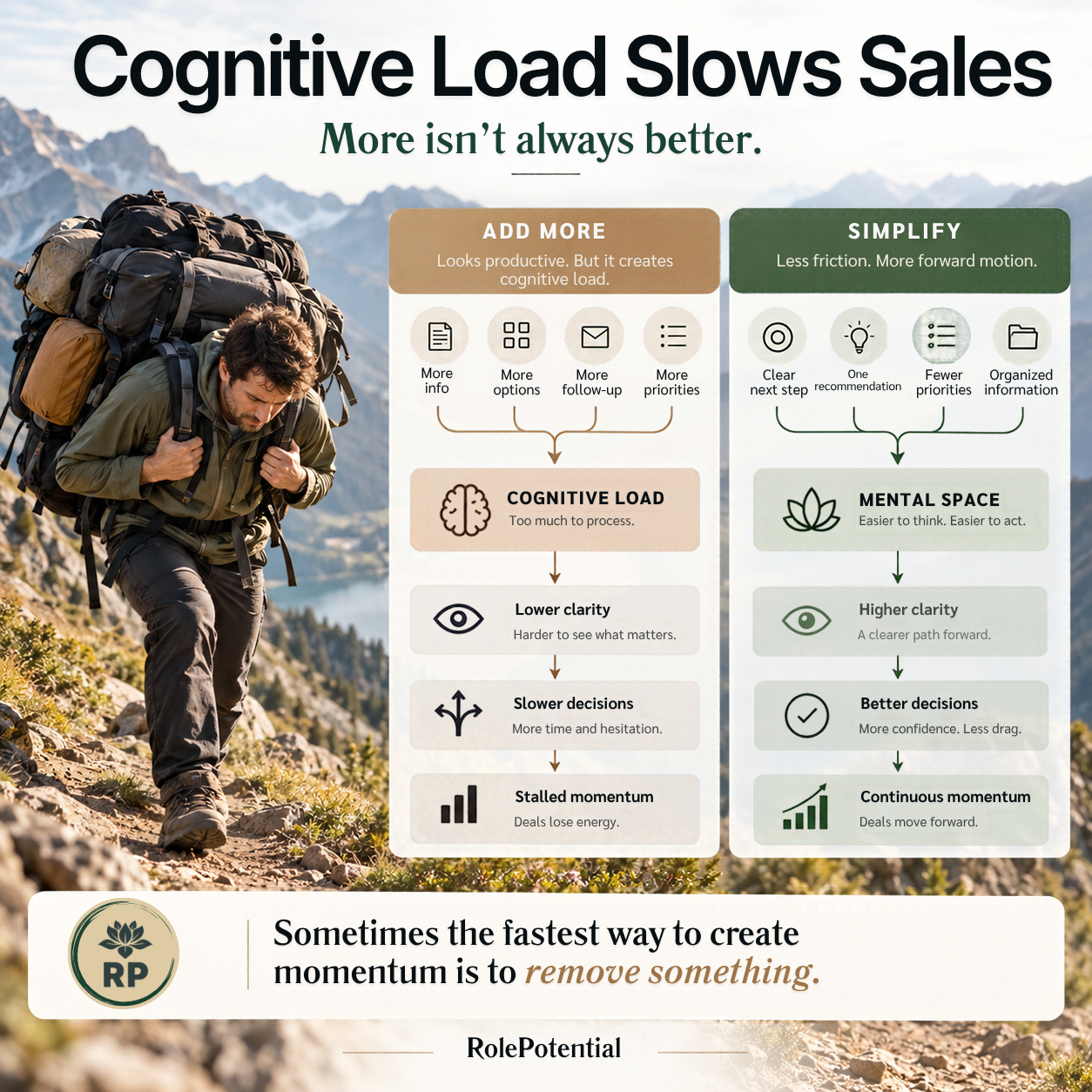
Reducing cognitive load does not mean making sales simplistic. Complex decisions are still complex. Enterprise buyers may still need multiple stakeholders, detailed analysis, security reviews, financial justification, and implementation planning. The goal is not to remove necessary complexity. The goal is to stop adding unnecessary complexity. That requires discipline from both reps and leaders.
A useful question for reps is: “What does this buyer actually need to understand next?”
Not everything they could understand. Not every asset marketing created. Not every feature you can demonstrate. What do they need next?
If the buyer already understands the problem, stop proving the problem. If they already believe in the solution, stop repeating the value proposition. If their concern has shifted to implementation, help them understand implementation. If they need internal alignment, help them prepare for that conversation.
The best next step often removes uncertainty rather than adding information.
That might mean:
The salesperson becomes an organizer of complexity. That is a very different role from simply being a source of information. And in a world where buyers can access enormous amounts of information on their own, organizing complexity may be one of the most valuable things a salesperson can do.
Sales leaders should apply the same principle to their teams. When execution begins slipping, before adding another initiative, ask:
This does not mean avoiding accountability. It means recognizing that focus is not created by continuously adding priorities.
Focus is created by choosing.
A strong sales environment helps people understand:
That creates mental space. And mental space creates better decisions.
Explore the core sales performance problems to see how system design, leadership behavior, and buyer experience can create friction long before it appears in revenue.'
This may be the most important lesson. Sales teams naturally associate momentum with addition. Another email. Another meeting. Another argument. Another proof point. Another option. But sometimes the strongest move is subtraction. Remove one decision. Remove one unnecessary step. Remove one competing priority. Remove one slide. Remove one question. Remove one layer of ambiguity.
The buyer does not always need more reasons to move. Sometimes they need fewer things to think about before they can. The same is true for reps.= And that is where the people-first approach becomes commercially important.
Understanding human capacity is not separate from performance. It is part of performance.
Before responding to a stalled deal or struggling rep with more, leaders can ask: “Is the problem a lack of effort or too much cognitive load?”
Those require completely different responses.
If effort is genuinely the issue, accountability matters.
If cognitive load is the issue, adding pressure may make the problem worse.
Strong leadership means knowing the difference. See how we support sales leaders who want to build environments where people can think clearly, adapt confidently, and execute consistently.
Sales does not improve simply because we add more to it. More information does not automatically create confidence. More options do not automatically create value. More activity does not automatically create progress. And more pressure does not automatically create better execution.
Buyers and sellers are human. Their ability to pay attention, process information, manage uncertainty, and make decisions has limits. The strongest sales systems respect those limits without lowering the standard. They organize complexity.They protect attention. They simplify what can be simplified. And they make the next decision easier to understand.
Because sometimes the fastest way to create momentum is not to add another thing. It is to remove one.
If you're looking to help your team reduce unnecessary friction, improve buyer decision-making, and create a sales environment where people can perform without constant overload, explore our approach.


