

A lot of sales teams are taught one of the most damaging lies in the profession: that great performance should look the same all the time.
That model gets normalized so early that many people stop questioning it. They assume the best teams are the ones that can stay activated all the time. They assume steadiness means maintaining the same intensity every week. They assume leadership means keeping pressure high enough that momentum never drops. They assume a team is healthy if it can keep moving without pause.
But that assumption creates a lot of damage. Because sales is not linear. And neither are people.
Regenerative Sales says, growth is not linear, teams that honor seasons outperform teams that fight them, and the healthiest sales systems move through spring, summer, fall, and winter rather than trying to live in one permanent mode. That is one of the clearest regenerative sales truths there is.
Sales has seasons. Not as a metaphor alone. As an operating principle.
And once leaders truly understand that, they start managing the system differently. They stop treating every dip like failure. They stop demanding the same kind of energy from every phase. They stop assuming urgency is the answer to every slowdown. They start designing rhythm instead of defending flatline intensity. That is what this post is about.
Not whether urgency has a place. But why teams perform better when they stop fighting the natural cycles of growth, execution, reflection, and renewal.
Most sales teams are not just overworked. They are mispaced. That is an important distinction.
Overwork is about volume.
Mispacing is about using the wrong kind of energy at the wrong time for too long.
A flatline sales culture tells people to stay equally switched on across every phase of the quarter. It treats prospecting like closing. It treats building like harvesting. It treats recovery like laziness. It treats reflection like lost time. That is why so many teams feel like they are running hard but not getting stronger. Because they are using effort without rhythm.
Our Regenerative Sales Playbook (contact us for your copy) makes this point clearly when it contrasts pressure with rhythm and says that sales is built on cycles, not sprints. Teams that ignore rhythm burn out. Teams that honor it build consistency. That is the real cost of flatline culture. It does not just exhaust people. It teaches them to ignore signal. They stop noticing when a deal needs patience instead of pressure. They stop noticing when the team needs reflection instead of more motion. They stop noticing when leadership is responding to fear instead of the actual season of the work.
Eventually, everything starts getting managed with the same blunt instrument: more urgency.
That may produce movement. But it rarely produces maturity.
One of the reasons this concept matters so much is that sales teams already move through seasons. Even teams that deny it are living inside it. There are periods of prospecting and planting. Periods of nurture and development. Periods of focused closing. Periods of slowdown, reflection, or reset.
These show up inside quarters, inside years, inside individual deals, and across the broader business cycle.
RolePotential names this at three levels:
That is a powerful framework because it tells leaders something important: you are not creating the seasons. You are deciding whether your team has language and practices to work with them intelligently.
If you do not name the season, people still feel it. They just interpret it badly.
That creates cultural distortion. When leaders name the season, the team can recalibrate instead of panicking.
One of the strongest things about our playbook is how clearly it defines the four seasons.
This is the season of curiosity, exploration, and foundations.
The work is about planting what will pay off later.
The energy is lighter, more open, more outward-looking.
The leadership job is vision, inspiration, and early alignment.
This is the season of nurturing.
Momentum starts building.
Deals deepen.
Relationships expand.
The leadership job becomes coaching, pacing, and staying connected to what is growing.
This is the season of focus.
Deals come to close.
Execution matters.
Recognition matters.
The leadership job is to help the team harvest well without turning the whole system into panic.
This is where many traditional systems fail.
Winter is the phase most extraction-based cultures do not know how to respect.
But your playbook makes the case that winter is not weakness. It is renewal, pattern recognition, learning, and preparation for the next cycle.
This framework matters because it changes how leaders interpret what is happening.
A softer quarter start does not automatically mean poor performance.
A slower deal stage does not automatically mean loss of momentum.
A post-close dip in energy does not automatically mean people are disengaged.
Sometimes the team is in a different season.
And the smartest thing leadership can do is work with that reality instead of against it.
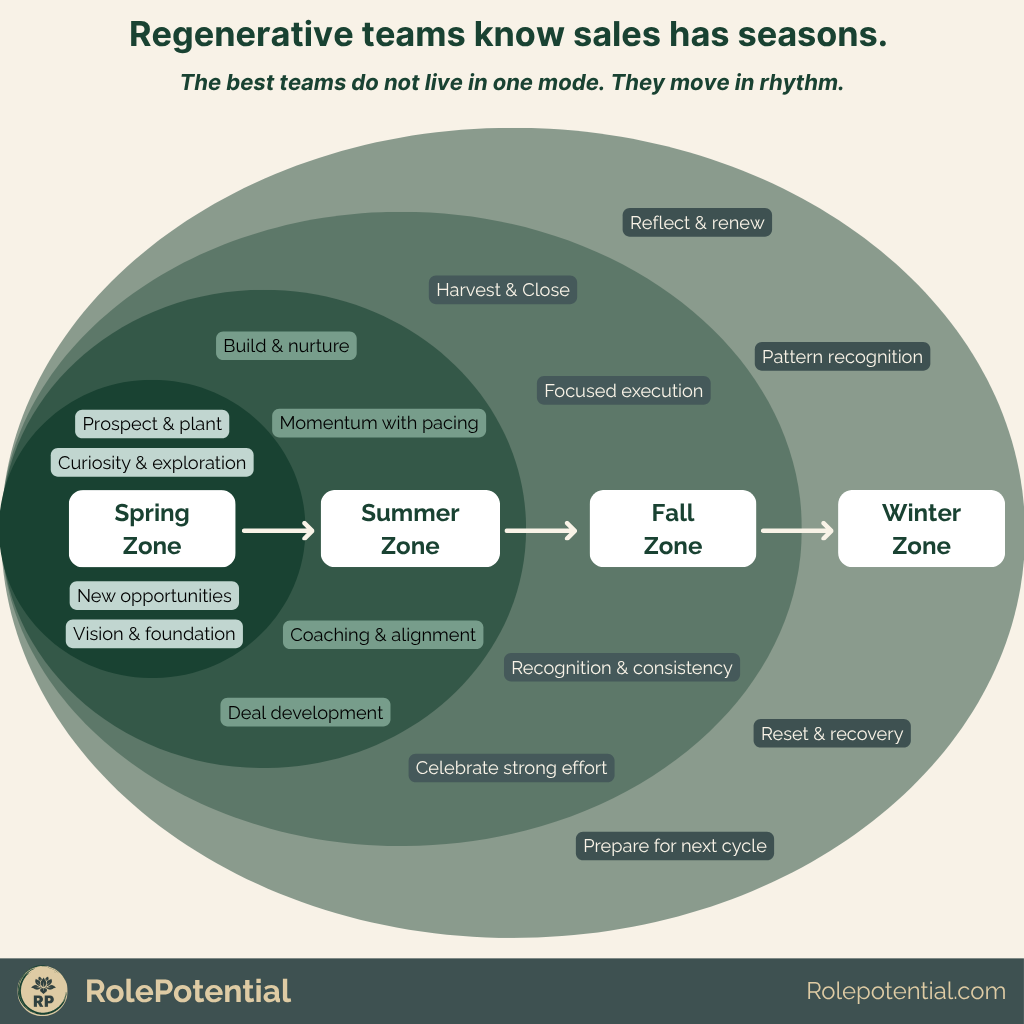

This is where most sales teams get into trouble. They treat every moment like it is harvest season.
Close harder. Push faster. Advance the deal. Get the meeting. Move the number. Drive the next step. Increase urgency.
But if you try to harvest in spring, you weaken the roots. If you try to close in a moment that needs nurturing, you create buyer resistance. If you refuse winter, the system never really renews. If you keep the team in permanent fall, they eventually lose their ability to trust any other pace. That is why always-on cultures become so costly. We shared that a few lessons ago in "Your team's always-on culture is costing you quota."
They erase seasonal intelligence.
The team loses the ability to distinguish between:
Our playbook argues that pressure builds speed, but rhythm builds strength. That line captures the whole problem. Because a team that only knows how to push may still hit numbers in bursts. But it usually struggles with consistency, recovery, and long-term resilience.
Winter deserves its own section because it is usually the most resisted season in sales. That makes sense. Sales cultures are often built to value visibility. Motion. Urgency. Forward energy. Immediate action. Talk tracks, meetings, follow-up, momentum.
Winter looks like the opposite. Pause. Review. Debrief. Letting lessons settle. Naming what drained the team. Asking what needs to be renewed. Looking backward before charging forward.
Many leaders are uncomfortable there. They worry it will lower standards. They worry it will slow the team down. They worry it will feel soft. But regenerative sales frames winter differently. It positions winter as a necessary phase of learning, rest, and reset, where post-loss reviews, reflection huddles, and renewal rituals help the team recover and prepare well for the next cycle.
Winter is not softness. It is maintenance.
And systems that do not know how to maintain themselves become more fragile every quarter.
If a team never has winter, it eventually pays for that elsewhere.
Once you accept that sales has seasons, leadership changes. The job is no longer just to drive. It is to calibrate.
That means asking:
Regenerative sales brings this into practical leadership language with questions like:
That is a better leadership discipline than constant urgency. Because urgency only gives you one setting. Seasonal calibration gives you range.
A calibrated leader can:
This matters especially in volatile periods. When the market shifts. When pipeline softens. When a quarter starts strangely. When a team loses momentum. When recovery is needed. The wrong leader sees every one of those moments as a reason to increase force. The better leader sees them as a reason to understand the season more clearly.
One of the best applications of this framework is at the deal level. Because deals have seasons too.
A deal begins in spring: interest, possibility, discovery, early exploration.
Then it moves into summer: nurturing, stakeholder conversations, alignment-building, momentum.
Then fall: decision-making, closing, commitment, harvest.
Then winter: reflection, onboarding handoff, learning, reset before the next cycle.
Our playbook makes this exact point and encourages leaders to use seasonal language in pipeline reviews, asking things like, “This deal looks like it’s in summer — how are we nurturing it so it keeps growing?” That is a simple but powerful shift. Because once a leader starts naming the season of the deal, the conversation gets smarter. The team stops asking only, “How do we move it?” They start asking, “What does this phase need?” That leads to better pacing, better buyer trust, and better decision quality.

Movement is being pushed before alignment is strong enough.
Instead of diagnosing the moment, they try to override it.
There is no real winter in the system.
There is no variation in tone, pacing, or energy.
Wins happen, but the group gets weaker instead of stronger.
These are strong signs that the system is not missing effort.
It is missing rhythm.
A seasonal sales culture does not mean the team becomes slow. It means the team becomes better paced. There is still ambition. Still stretch. Still accountability. Still strong execution. But the culture stops treating one kind of energy as the answer to everything.
In a seasonal culture:
That changes the feel of the work. Reps stop interpreting every slowdown as failure. Leaders stop reacting to every dip as a threat. Pipeline reviews get more intelligent. Recovery becomes part of performance instead of a guilty secret. The team starts building trust with its own rhythm. That is what makes sustainable performance possible.
This is one of the easiest regenerative shifts to apply because it starts with language and rhythm. Want more ideas, take our regenerative sales leadership course or check out our leadership page.
In team meetings, 1:1s, and pipeline reviews, say it out loud. What season are we in right now?
Our playbook provides examples:
Run quarterly reflection huddles using the seasonal prompts in the playbook:
A team that renews well performs better under pressure later.
Sometimes what looks like a performance issue is actually a pacing issue.
Seasonal language helps leaders diagnose that faster.
The real question is not whether your team has seasons. It does. The question is whether your leadership style and operating rhythm are helping the team work with them wisely. Because when sales cultures deny seasons, they usually create one of two outcomes: constant pressure or quiet burnout
Neither is sustainable.
But when sales teams understand seasons, everything gets clearer.
That is why this concept matters so much. Sales does not need flatter intensity. It needs better rhythm. Sales has seasons. The best teams know how to honor them.