

Buyer personas are not just something sales teams define before outreach. They show up in real time. In the questions buyers ask. In the details they focus on. In the way they respond to uncertainty. In the pace they prefer. In what makes them lean in or pull back.
That is what makes Behavioral Clusters useful.
They help reps understand how prospects listen, think, learn, and make decisions during the actual sales conversation. Not as a fixed label. As a live signal.
A buyer may start the process as a Visionary, excited by what could be possible. Then later, once implementation becomes real, that same buyer may shift into a Pragmatist. Another buyer may begin as a Relationship Builder, focused on trust and fit, then become more Analyst-like when internal approval starts.
The key is not memorizing eight personality types. The key is learning how to read the buyer in front of you.
Because once you know which cluster is active, you can respond in a way that builds confidence instead of adding friction.
Before we go further, this matters: Behavioral Clusters are not about putting buyers in boxes.
They are about paying attention. The goal is not to say: “This person is an Analyst forever.” The better question is: "What does this buyer seem to need right now in order to move forward responsibly?” That question changes the sales conversation and the sales reps behaviors. Instead of defaulting to the same pitch, same follow-up, or same next step, the rep starts adjusting based on what the buyer is actually signaling.
A strong sales conversation becomes less about pushing information. It becomes more about matching the buyer’s decision process. That is where momentum starts.
You can usually identify a buyer’s active Behavioral Cluster by listening for five things.
Questions are one of the clearest signals.
An Analyst asks about evidence, comparisons, and criteria.
A Pragmatist asks about rollout, process, and next steps.
A Visionary asks about future impact and possibility.
A Relationship Builder asks about support, people, and partnership.
The buyer’s questions often reveal what confidence requires. Do not rush past them. Listen to the pattern.
Hesitation is useful information. A buyer may pause when the business case feels unsupported. Or when implementation feels vague. Or when the process feels too fast. Or when the partnership does not yet feel trustworthy.
Different buyers hesitate for different reasons. The pause is not automatically resistance. It is often a signal that something important has not been addressed yet.
Notice what makes the buyer lean in. Do they respond to data? Stories? Visuals? Roadmaps? Options? Team introductions? Written summaries?
The format that creates engagement usually tells you how the buyer learns. A rep who notices this can adjust quickly.
Some buyers want to move fast. Some need more time to process. Some want to explore before deciding. Some need structure before they can move.
Pace is not a small detail. If you move too slowly with a Fast Mover, they disengage. If you move too quickly with a Passive Buyer, they become more cautious. The right pace helps the buyer stay oriented.
Every buyer is managing risk. But not all buyers focus on the same kind.
When you understand the risk the buyer is trying to reduce, the next step becomes much clearer.

Here is a practical way reps can start identifying clusters during calls.
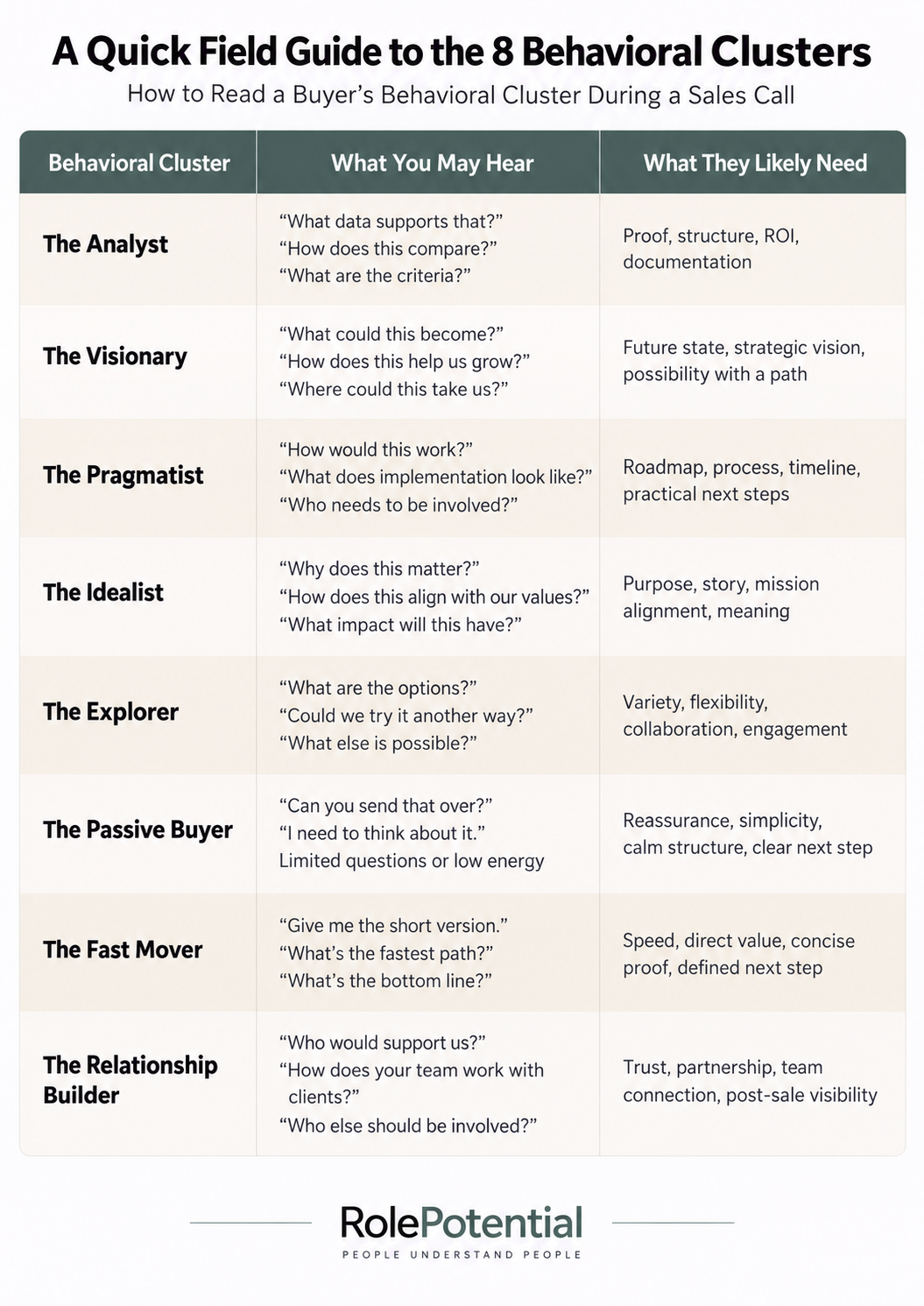
Reading the cluster is only half the work. The next step is adjusting your response.
Small shifts like this can change the entire tone of the call. The buyer feels understood. The rep stops guessing. The conversation becomes more useful.
One of the biggest mistakes reps make is assuming the buyer’s cluster stays the same for the whole deal. It may not. A buyer can shift as the decision becomes more real. Early in discovery, they may sound like a Visionary. During evaluation, they may become an Analyst. During proposal, they may become a Pragmatist. Near close, they may become a Relationship Builder because they are thinking about support, trust, and handoff.
That shift is normal. Buying is not one moment. It is a sequence of decisions. Each stage can activate a different need.
That is why reps should keep asking themselves: “What does this buyer need right now?”
Not: “What did they need on the first call?”
This keeps the conversation aligned with the buyer’s current state. Most teams struggle with deeper issues that affect buyer confidence long before they affect revenue. Explore the core sales performance problems.

After each meaningful call, reps can use this three-part reflection:
Name the likely cluster based on what the buyer said and asked.
List the evidence. Was it their questions? Their pace? Their hesitation? Their request for information?
Decide whether the next step should include proof, vision, process, reassurance, speed, options, trust-building, or purpose alignment. This takes two minutes. But it makes follow-up much sharper. Instead of sending a generic recap, the rep sends the kind of follow-up that matches the buyer’s decision process. That is where personalization becomes practical.
Sales leaders can use Behavioral Clusters to improve deal coaching.
Instead of only asking: “What’s the next step?”
Ask: “What cluster is active right now?”
Then follow with:
These questions help reps think beyond activity and stage. They help reps understand the human process underneath the deal. Creating this kind of sales environment is a leadership discipline. See how we support sales leaders.
Traditional sales often asks reps to control the conversation. Regenerative sales asks reps to understand the conversation. That does not mean being passive. It means being more attuned. The best reps are not just good presenters. They are good readers of buyer behavior. They notice what buyers need. They adjust without becoming inauthentic. They guide without pressure. They create momentum by helping buyers move through the decision in a way that matches how they listen, think, learn, and decide.
That is the real value of Behavioral Clusters. They give reps a way to see the buyer more clearly. And when reps see buyers more clearly, selling starts to feel less like persuasion. More like partnership.
Buyer personas are not just researched before the call. They are revealed during the call. In the questions. In the pauses. In the pace. In the kind of information that creates confidence.
The better reps get at reading those signals, the better they become at guiding buyers. Not by pushing harder. By responding more accurately. And that is where stronger sales conversations begin.
If you're looking to help your team create stronger buyer confidence, better conversations, and more consistent momentum, ask about our Behavioral Cluster bootcamp or explore our approach to helping teams succeed.