

A lot of sales teams think buyer experience lives in the front-end layer.
Those things matter. But they are not the full story. Because buyer experience is not just shaped by what your reps do. It is shaped by what your culture teaches them to do under pressure. That is the deeper truth. A buyer does not need access to your org chart to feel the leadership style behind the team. They do not need to sit in your pipeline reviews to feel whether your system runs on fear or trust. They do not need to know your quota pressure to sense whether urgency is distorting the interaction. They do not need to read your values page to tell whether your sales culture sees them as a partner or a target.
They can feel it. In how quickly a rep pushes. In how carefully a rep listens. In how often a rep chases movement before clarity. In whether the process feels collaborative or extractive. In whether the conversation expands trust or compresses it. That is why buyer experience matters so much in regenerative sales. It is not just a customer-facing outcome. It is a cultural signal.
Our Regenerative Sales Playbook (message us if you want a copy) makes this clear in several places. It positions buyers as active co-creators rather than passive recipients, emphasizes buyer trust and buyer-seller alignment as key regenerative metrics, and frames the future of sales as a shift from transactions to partnerships. That is what this post is about. Not just how buyers feel in a sales process. But what that feeling reveals about the culture behind it.
Sales leaders often separate internal culture from external experience. Culture is what happens inside the team. Buyer experience is what happens in the market. But in practice, the two are tightly connected. A fear-heavy culture usually creates fear-heavy behavior. An always-on culture usually creates rushed interactions. A control-heavy leadership style often creates less adaptive reps. A system obsessed with short-term movement usually creates buyers who feel pushed before they feel understood.
The opposite is also true.
A trust-based culture creates more thoughtful selling. A reflective culture creates stronger discovery. A rhythm-based culture creates cleaner timing. A regenerative system creates more space for alignment, honesty, and mutual clarity. This is one of the most important ideas in our playbook: what happens inside the sales system eventually shapes what happens between seller and buyer. Buyer trust, buyer collaboration, transparency feedback, deal slippage reduction, expansion revenue, renewal, and referrals are all presented as signals of whether the internal system is healthy.
So when a buyer experience feels tense, pushy, vague, transactional, or prematurely urgent, that is rarely just an individual rep issue. It is often the front-end expression of a back-end pattern.
Pressure-based buyer experience is not always aggressive. Sometimes it is subtle. It can sound polished. It can be highly responsive. It can even look organized. But underneath that surface, there is a feeling the buyer can pick up on: This seller wants movement more than understanding.
That feeling can show up in a lot of ways.
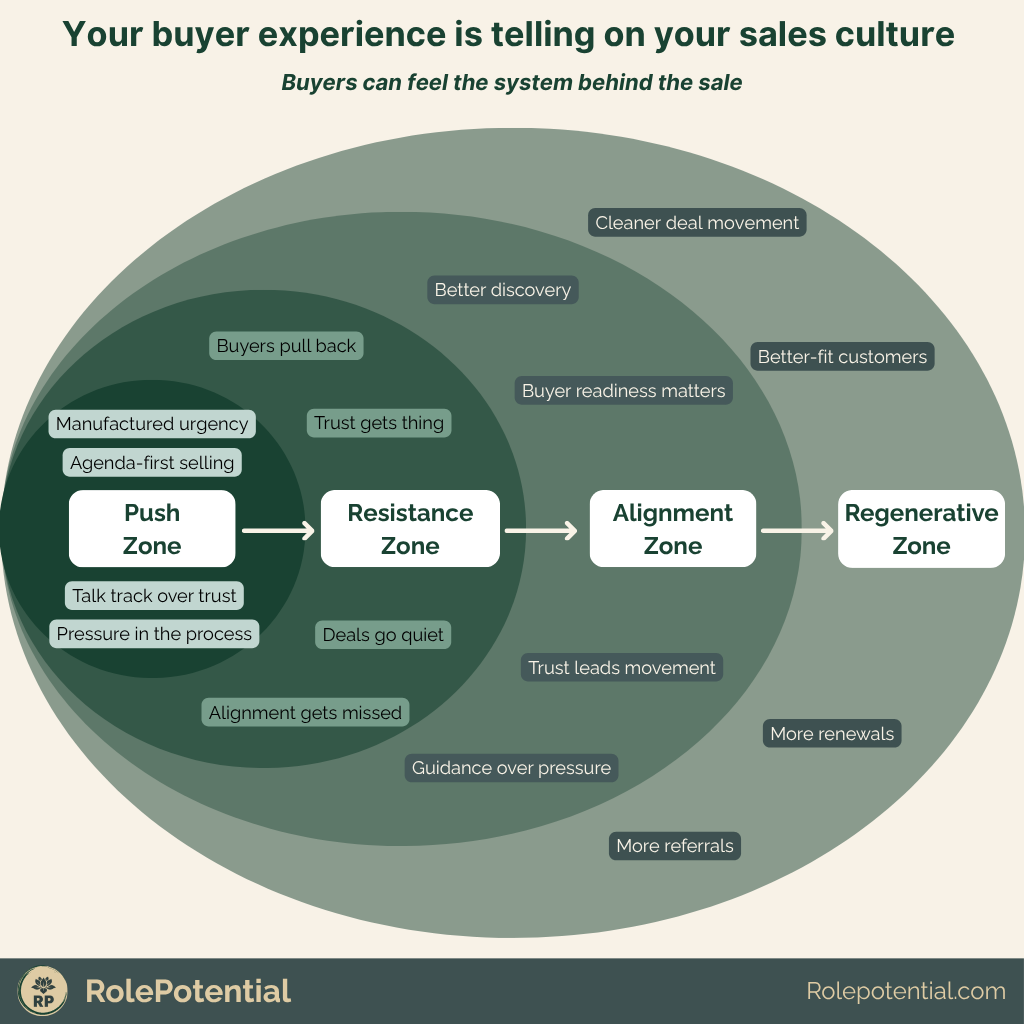
None of that requires bad intent. It usually comes from internal pressure. When a rep is being taught, directly or indirectly, that progress must always be visible, that silence is dangerous, that slowness is risk, and that leadership expects motion at all times, the buyer feels the resulting behavior. Regenerative Sales describes the old system as one where buyers feel pushed rather than guided, and contrasts that with regenerative sales where buyers feel safe, respected, and ready to move. That is the divide.
Trust is one of the clearest signals of sales-culture health because it cannot be faked for long. A team can script professionalism. A rep can learn polished language. A process can be made to look buyer-friendly. But trust reveals whether the interaction is actually aligned. That is why our playbook uses buyer trust and relationship health as one of its core metrics. Leading indicators include buyer engagement, feedback, proactive communication, collaboration, and transparency. Lagging indicators include renewal rate, NPS, referrals, and expansion. Those are not just commercial outcomes. They are cultural reflections.
Because trust grows when buyers feel:
A team that creates those conditions usually has something healthy happening internally. A team that struggles to create those conditions usually does not need more buyer-experience tactics. It usually needs a better sales system. It needs a Regenerative Sales System, you can find out more here.

This is one of the most overlooked truths in sales. Buyers can often tell when a rep is not operating from steadiness. They can feel when the rep is over-scripted. They can feel when timing is being forced. They can feel when every answer sounds approved but not fully present. They can feel when a rep is trying to protect a forecast. They can feel when the interaction is more about internal pressure than external fit. That matters because many sales organizations still believe buyer experience is mostly about rep polish. It is not. It is about behavioral signal.
If a rep does not have enough room to think, calibrate, reflect, and adapt, then the buyer will eventually interact with the pressure that is constraining the rep. That is why regenerative sales leadership matters to buyer experience.
Buyer-seller alignment is one of the strongest concepts in your playbook, and one of the most useful. Because alignment is not the same as momentum. A deal can move and still be misaligned. A buyer can be responsive and still be uncertain. A next step can be scheduled and still be weak. A proposal can be requested and still be premature.
Alignment means something deeper. It means the buyer’s goals, concerns, readiness, and internal reality are being understood clearly enough that movement makes sense. Early goal alignment and mutual action plans are leading indicators; reduced deal slippage and expansion revenue are lagging signs that alignment is real.
That is why regenerative sales puts so much emphasis on clarity. Because without clarity, movement becomes noisy. And noisy movement makes buyer experience worse. The buyer starts feeling managed instead of supported. The seller starts chasing responsiveness instead of building readiness. The process becomes performative instead of useful.
Alignment fixes that. It helps both sides move for the right reasons.
Discovery is one of the clearest places culture becomes visible. In a pressure-based culture, discovery often becomes compressed. Questions come quickly. The rep is listening for qualification more than understanding. The conversation narrows toward the solution too soon. Complexity gets flattened. The buyer’s internal world does not fully enter the room.
In a regenerative culture, discovery feels different. There is more patience. More curiosity. More context. More willingness to surface what is unclear. More respect for the buyer’s process. More room for real understanding before acceleration begins.
This does not make the interaction slower in a bad way. It usually makes it cleaner. Because it reduces the need for later-stage force. That aligns directly with your playbook’s claim that deals move faster when trust leads, and that slowing down in the right moment can help speed up later.

The interaction looked active, but real trust or alignment did not deepen.
The process is privileging movement over readiness.
Professionalism is present, but partnership is missing.
Momentum was created before shared understanding was built.
The team may be closing deals, but not creating the trust that compounds afterward.
These are not only buyer-experience issues.
They are often culture issues wearing customer-facing clothes.
A regenerative buyer experience does not feel passive. It still has direction. It still has standards. It still has momentum. But it feels different in tone and structure. It feels collaborative without being vague. It feels guided without being forceful. It feels honest without being heavy. It feels thoughtful without becoming slow. It feels like the seller is helping the buyer make a good decision, not merely trying to secure one.
The shift from transactions to partnerships, from persuasion to alignment, and from static selling to a living rhythm where buyers and sellers meet in trust rather than resistance. That kind of experience creates better business outcomes because it creates better decision quality. The buyer understands more. The seller understands more. The fit becomes clearer. The next step becomes more meaningful. The relationship starts from a stronger foundation.
That is what makes regenerative buyer experience so powerful. It is not just nicer. It is stronger.
Many teams respond to buyer-experience issues by adjusting messaging, templates, and process steps. Those can help. But if the culture underneath is still pressure-heavy, the scripts will only go so far. Leaders need to work deeper than the front-end layer. Here are five shifts that matter:
Ask what the buyer needs to feel ready, not only what the rep needs to send next.
Internal fear often leaks outward. Internal steadiness often does too.
When leaders ask better questions, reps learn to bring better buyer signal into the conversation.
A deal that is well-aligned deserves recognition even before it closes, because that behavior strengthens the whole system.
If your company says “we partner with buyers,” the sales culture has to reinforce behaviors that make buyers feel that is true.
These shifts map directly to your playbook’s emphasis on partnership, trust, buyer empowerment, and alignment as the healthier path to performance.
Buyer experience matters more now because buyers are more sensitive to noise.
That means weak sales cultures get exposed faster. A rushed team feels rushed. A misaligned team feels misaligned. An over-managed team feels over-managed. And the market responds accordingly. Not always with explicit feedback. Often with quieter signals: slower trust, less openness, more ghosting, more slippage, less expansion, and less advocacy
That is why buyer experience is not a soft topic. It is one of the clearest mirrors a sales organization has.
If your buyer experience feels inconsistent, the question is not only: Do our reps need better tactics?
It is also:
What is our culture teaching reps to optimize for?
What kind of pressure are buyers feeling from our internal system?
Are we helping buyers feel ready, or just trying to get them moving?
Does our process communicate partnership, or does it reveal extraction?
What is the buyer experiencing that reflects how our team actually works?
Because buyers are always learning something from the sales experience. Not just about your product. About your culture. And if your culture is healthy, aligned, reflective, and trust-building, the buyer will feel that too. That is what regenerative sales changes. It does not only improve the inside of the system. It transforms what the outside of the system feels like. And that is where stronger deals, stronger trust, and stronger long-term growth begin.